What's recent past in French (and how to use it)
Have you just started learning French and think that talking about the past is an impossible task? Think again. It's much easier than you think!
 Jérôme4 November 2026, 6 min read

I know how it feels: you've only just started learning French, and you can't wait to go out and explore the world, dive into a new culture and chat with the locals… but suddenly, you realize you're going to struggle to express yourself, especially when you want to tell people what you've just done…
Trust me, I was exactly like you when I started learning German, English and Mandarin. But don't worry! In French, talking about the past isn't that hard. Well, at least one kind of past. Let me explain.
How to build it
First things first: what you absolutely need to know is how to conjugate the verb venir in the present tense. It's an irregular verb from the third group, which can be a bit scary at first, but don't worry: Jérôme is here to help. Here's what it looks like:
The verb venir…
| Pronoun | Conjugation |
|---|---|
| je | viens |
| tu | viens |
| il / elle / on | vient |
| nous | venons |
| vous | venez |
| ils / elles | viennent |
Learn how to conjugate this verb. Say it out loud a few times. Congratulations, you've done half the work!
… one preposition to rule them all…
Now that you know how to conjugate venir, you need to add a preposition right after the conjugated verb. That preposition is de: venir de.
| Pronoun | Conjugation |
|---|---|
| je | viens de |
| tu | viens de |
| il / elle / on | vient de |
| nous | venons de |
| vous | venez de |
| ils / elles | viennent de |
Careful: before a vowel or a silent h, de becomes d': je viens d'arriver, ils viennent d'expliquer.
One more step, and you'll be able to talk about the past.
… and a verb in the infinitive.
Yes! It's that simple. Once you've conjugated venir and added the preposition de, all you have to do is add any verb in the infinitive (as long as the sentence makes sense, of course!).
Examples:
- Je viens de manger…
- Tu viens de partir…
- Il vient de rentrer…
- Elle vient de finir…
- Nous venons de voir…
- Vous venez de dire…
- Ils viennent d'expliquer…
- Elles viennent de sortir…
This, my friends, lets you talk about an action that has just happened (in English, you'd say I've just eaten, you've just left…): it's called… le passé récent, the recent past.
Making it negative
Making a negative sentence couldn't be easier. As usual in the present tense, just put ne… pas around the conjugated verb.
Examples:
- Je ne viens pas de manger…
- Tu ne viens pas de partir…
- Il ne vient pas de rentrer…
- Elle ne vient pas de finir…
- Nous ne venons pas de voir…
- Vous ne venez pas de dire…
- Ils ne viennent pas d'expliquer…
- Elles ne viennent pas de sortir…
Of course, at a higher level, other negative structures are possible, but for now, it's better to build solid foundations.
Being able to make this kind of sentence already lets you talk about the fairly recent past. Take the time to practice and get used to this structure, and once you feel comfortable with it (it shouldn't take long), you'll be ready to move on.
Three levels of the recent past
Level 1
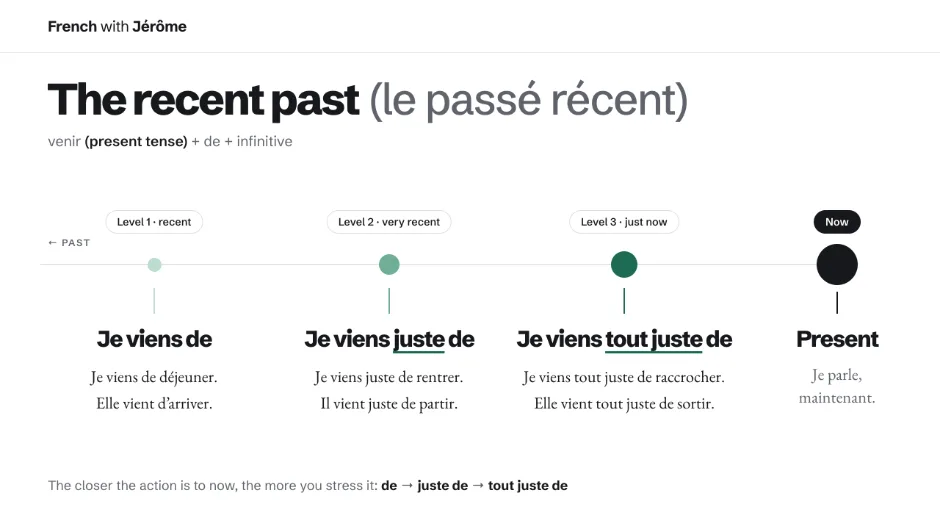
What I've just explained is what I call level 1 of the recent past. You use the verb venir, followed by the preposition de and a verb in the infinitive, to talk about something that happened not long ago. It could be weeks, days, hours or minutes ago.
Examples:
- Je viens d'acheter une nouvelle voiture. (I bought it a week ago, but to me, it still feels recent.)
- Elle vient d'accoucher. (She gave birth a few days ago. It didn't necessarily happen a few minutes ago.)
- On vient d'arriver chez nous. (We got home an hour ago.)
Note: the times in brackets aren't fixed: I'm only giving them as examples. They can vary from person to person, depending on what each of us considers more or less recent.
But there are two more levels you should know. They let you insist on how close the action is to the present: they show just how recent it is.
Level 2
When you want to show how recent an action is, you can add a little word to the basic structure, one that English speakers know very well: juste. Just put it directly after the conjugated verb venir, before de.
Examples:
- Je viens juste d'acheter une nouvelle voiture. (I bought it yesterday. I'm insisting that it's very recent.)
- Elle vient juste d'accoucher. (She gave birth an hour ago.)
- On vient juste d'arriver chez nous. (We got home about ten minutes ago.)
Level 3
As you've probably guessed, level 3 is even closer to the present. Here, we're talking about something that happened very, very recently. It's as close to the present as you can get.
To do this, start from the structure venir + juste + de + infinitive, and add one tiny word: tout. It goes just before juste.
Examples:
- Je viens tout juste d'acheter une nouvelle voiture. (I bought it this afternoon.)
- Elle vient tout juste d'accoucher. (She gave birth a few minutes ago.)
- On vient tout juste d'arriver chez nous. (We got home a few minutes / seconds ago.)
Mastering these three levels of the recent past gives you more flexibility in your sentences.
Did something happen a few days ago? A few hours ago? A few minutes ago? A few seconds ago? Choose the right level of the recent past. Don't always use the same one. Mix it up!
One last thing
Now that you know the recent past, you'll probably be tempted to see it everywhere! But be careful: venir + de isn't only used for the recent past.
With venir + de, you can also say where you come from. To tell them apart, look at what comes after the preposition:
- if it's a verb in the infinitive, it's the recent past;
- if it's a place, it tells you where someone comes from.
Examples:
- Nous venons de faire un jogging. (← recent past)
- Elle vient de finir de manger. (← recent past)
- Je viens de Lyon. (← where I come from)
- Ils viennent des États-Unis. (← where they come from: de + les = des)
In a nutshell
- venir (in the present) + de + infinitive: something has just happened.
- Add juste, then tout juste, to bring it even closer to now.
- Before a vowel or a silent h, de becomes d'.
- After venir de, a verb means the recent past; a place means where you come from.
Your turn!
Complete these sentences with venir de, at the level given in brackets. No peeking at the answers!
- Nous ___ dîner. (level 1)
- Tu ___ rentrer ? (level 2)
- Le film ___ commencer. (level 3)
- Je ___ arriver à Paris. (level 1)
- Elles ___ partir. (level 2)
Answers:
- Nous venons de dîner.
- Tu viens juste de rentrer ?
- Le film vient tout juste de commencer.
- Je viens d'arriver à Paris. (Careful: d' before a vowel!)
- Elles viennent juste de partir.
Now, tell me in the comments: what have you just done? Write your sentence in French, with venir de, venir juste de or venir tout juste de. I'll start: je viens tout juste de finir cet article. Your turn!
Hear it for real. Short stories in natural French, with the text following the voice word by word.
Listen to a storyKeep reading
-
 Grammar
Ces, ses, c'est or s'est? One Simple Test for Each
Four spellings, one sound. Here's what each one means, a quick test to pick the right one every time, and real examples you can listen to.
13 October 2026, 5 min read -
 In FrenchB1-B2
Le quart d'heure mondain
Combien de minutes de retard sont acceptables pour un dîner entre amis en France ? La réponse officielle : zéro. La réponse réelle : quinze.
27 October 2026, 11 min readRead aloud by Jérôme, 9 min -
 In FrenchB1-B2
Mon après-midi au Festival Lumière (avec Zhang Ziyi)
Festival Lumière 2026 : j’ai revu Tigre et Dragon sur grand écran, en présence de Zhang Ziyi. Un récit en français facile, avec un petit lexique.
14 October 2026, 9 min readRead aloud by Jérôme, 7 min
Comments