Ces, ses, c'est or s'est? One Simple Test for Each
Four spellings, one sound. Here's what each one means, a quick test to pick the right one every time, and real examples you can listen to.
 Jérôme13 October 2026, 5 min read

Ces, ses, c’est, s’est. Four ways to write what sounds, to most ears, like the same little word. If you have ever hesitated in the middle of a sentence, you are in very good company: French people hesitate too, and plenty of them get it wrong.
In my dictations, this is one of the traps that catches students most often. And it makes sense: your ear can’t help you here, because the sound gives you no clue. What you need is not a better ear, it’s a test. One quick test for each word, and you will choose the right one every time.
1. Ces = these, those
Ces points at things. It is the plural of ce, cet and cette.
Examples:
- Ces livres sont à moi. → These books are mine.
- Tu vois ces nuages ? → Do you see those clouds?
The test: put the sentence in the singular. If you get ce, cet or cette, then it’s definitely ces.
Examples:
- Ces étudiants → cet étudiant
- Ces maisons → cette maison
You can hear it in my story L’incendie, at 9:21: « la décision de ces deux étudiants ». Arthur and Isabelle: these two students.
2. Ses = his, her, its
Ses says who the things belong to. It is the plural of son and sa.
The test: ask yourself “whose?”. If there is an answer (his, hers), it’s ses. You can also put it in the singular: you should get son or sa.
Example:
- Ses lunettes → sa paire de lunettes. Whose glasses? Hers. So: ses.
The trap for English speakers: ses does not tell you whether the owner is a man or a woman. Ses livres can mean his books or her books. In French, the possessive agrees with the thing owned, not with the person who owns it. So don’t look at the owner to choose between son, sa and ses: look at the word that comes after.
In L’incendie, at 5:03: « Arthur, plongé dans ses études d’anglais ». Arthur, absorbed in his English studies. Whose studies? His.
3. C’est = it is, this is
C’est is ce + est. It introduces or describes something. It is probably one of the first things you learned in French.
Examples:
- C’est une bonne idée. → It’s a good idea.
- C’est mon frère. → This is my brother.
The test: put the sentence in the past. If c’était works, it’s c’est.
Example:
- C’est une bonne idée. → C’était une bonne idée. It works: c’est.
In L’incendie, at 2:33: « C’est une rue à sens unique ». It’s a one-way street.
4. S’est = a verb in the past
S’est is se + est. You find it with reflexive verbs (se réveiller, s’endormir, se passer…) in the passé composé. That’s why it is almost always followed by a past participle: s’est réveillé, s’est endormie, s’est passé.
The test: say the same sentence with je. If you get je me suis, it’s s’est.
Example:
- Il s’est endormi → je me suis endormi. It works: s’est.
In L’incendie, at 8:57: « un homme d’une cinquantaine d’années […] s’est endormi sur son canapé ». A man in his fifties fell asleep on his sofa. That is how the fire started.
The sentence that has two of them
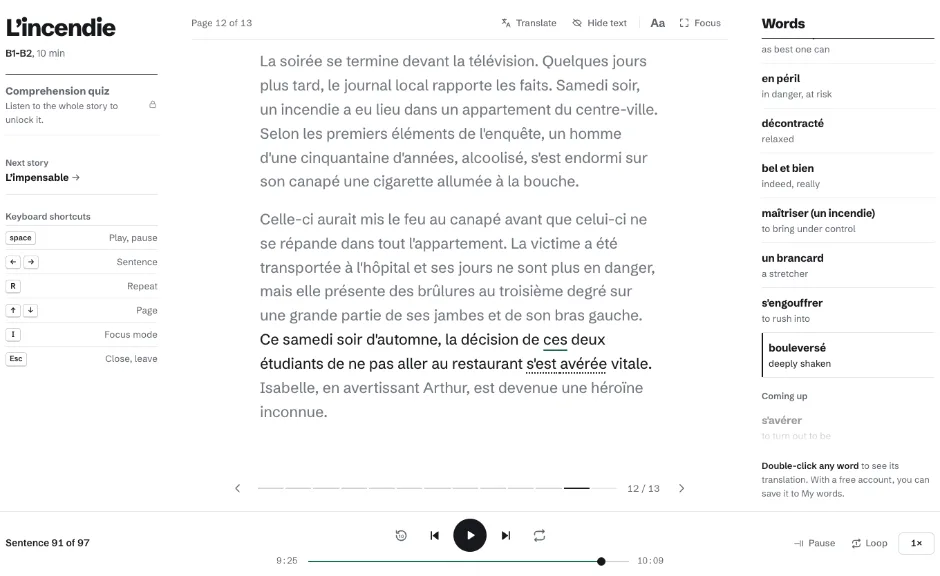
Now listen again to L’incendie at 9:21:
Ce samedi soir d’automne, la décision de ces deux étudiants de ne pas aller au restaurant s’est avérée vitale.
Two of our four words, in the same sentence, and your ear can’t tell them apart. Let’s use the tests:
- ces deux étudiants → cet étudiant: it’s ces.
- s’est avérée → je me suis avéré(e): it’s s’est.
The summary
| Word | Meaning | The test | Example |
|---|---|---|---|
| ces | these, those | in the singular: ce, cet, cette | ces étudiants |
| ses | his, her, its | “whose?”; in the singular: son, sa | ses études |
| c’est | it is, this is | in the past: c’était | c’est une rue |
| s’est | a verb in the past | with je: je me suis | il s’est endormi |
Bonus: sait and sais
Same sound again, but a different word: the verb savoir (to know). Je sais, tu sais, il sait, elle sait.
The test: put it in the past. If savait works, it’s sait or sais.
Example:
- Il sait nager → il savait nager. It works: sait.
Your turn
Save this cheat sheet, or share it with someone who mixes them up.
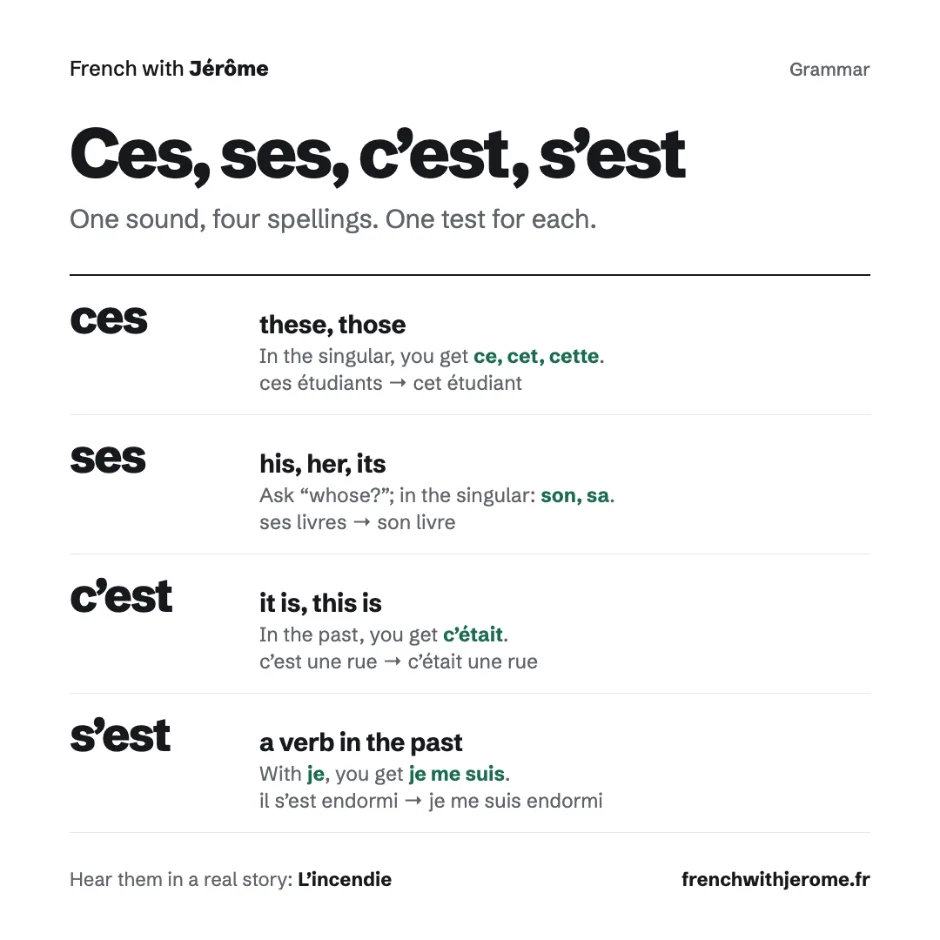
Fill in the gaps with ces, ses, c’est, s’est or sais. The answers are just below.
- Arthur range ___ affaires dans son sac.
- ___ une très bonne idée !
- Regarde ___ nuages, là-bas !
- Je ne ___ pas où il habite.
- Isabelle ___ réveillée très tôt ce matin.
Answers: 1. ses (whose things? Arthur’s). 2. C’est (c’était une très bonne idée). 3. ces (this cloud → ce nuage). 4. sais (je ne savais pas). 5. s’est (je me suis réveillée).
Train your ear and your eye together
These four words are the perfect example of what a dictation trains: you hear one sound, and you have to choose the right spelling. Every two weeks, I publish a new dictation, with every trap explained.
And to hear ces and s’est in a real story, start with L’incendie. It’s free, no account needed.
Questions learners ask me
Do ces and ses sound different from c’est and s’est?
In careful, standard French, ces and ses are often pronounced with a closed sound, like é, and c’est and s’est with a more open sound, like è. But in everyday speech, many French people don’t make the difference at all. That’s why you can’t rely on your ear: rely on the tests.
Should I say c’est or ce sont with a plural?
In writing, the correct form is ce sont: ce sont mes amis. In everyday speech, most people say c’est mes amis, and you will hear it all the time. Use ce sont when you write, and don’t be surprised by c’est when people talk.
What about sait and sais?
They sound the same too, but they come from the verb savoir. See the bonus above: if savait works, it’s sait or sais.
Hear it for real. Short stories in natural French, with the text following the voice word by word.
Listen to a storyKeep reading
-
 In FrenchB1-B2
Le quart d'heure mondain
Combien de minutes de retard sont acceptables pour un dîner entre amis en France ? La réponse officielle : zéro. La réponse réelle : quinze.
27 October 2026, 11 min readRead aloud by Jérôme, 9 min -
 In FrenchB1-B2
Mon après-midi au Festival Lumière (avec Zhang Ziyi)
Festival Lumière 2026 : j’ai revu Tigre et Dragon sur grand écran, en présence de Zhang Ziyi. Un récit en français facile, avec un petit lexique.
14 October 2026, 9 min readRead aloud by Jérôme, 7 min -
 Listening
Why Can't I Understand Spoken French? (And How to Fix It)
You read French fine, but real conversations fly past you. Here's why spoken French is so hard to catch, and a simple method to train your ear.
13 October 2026, 6 min read
Comments